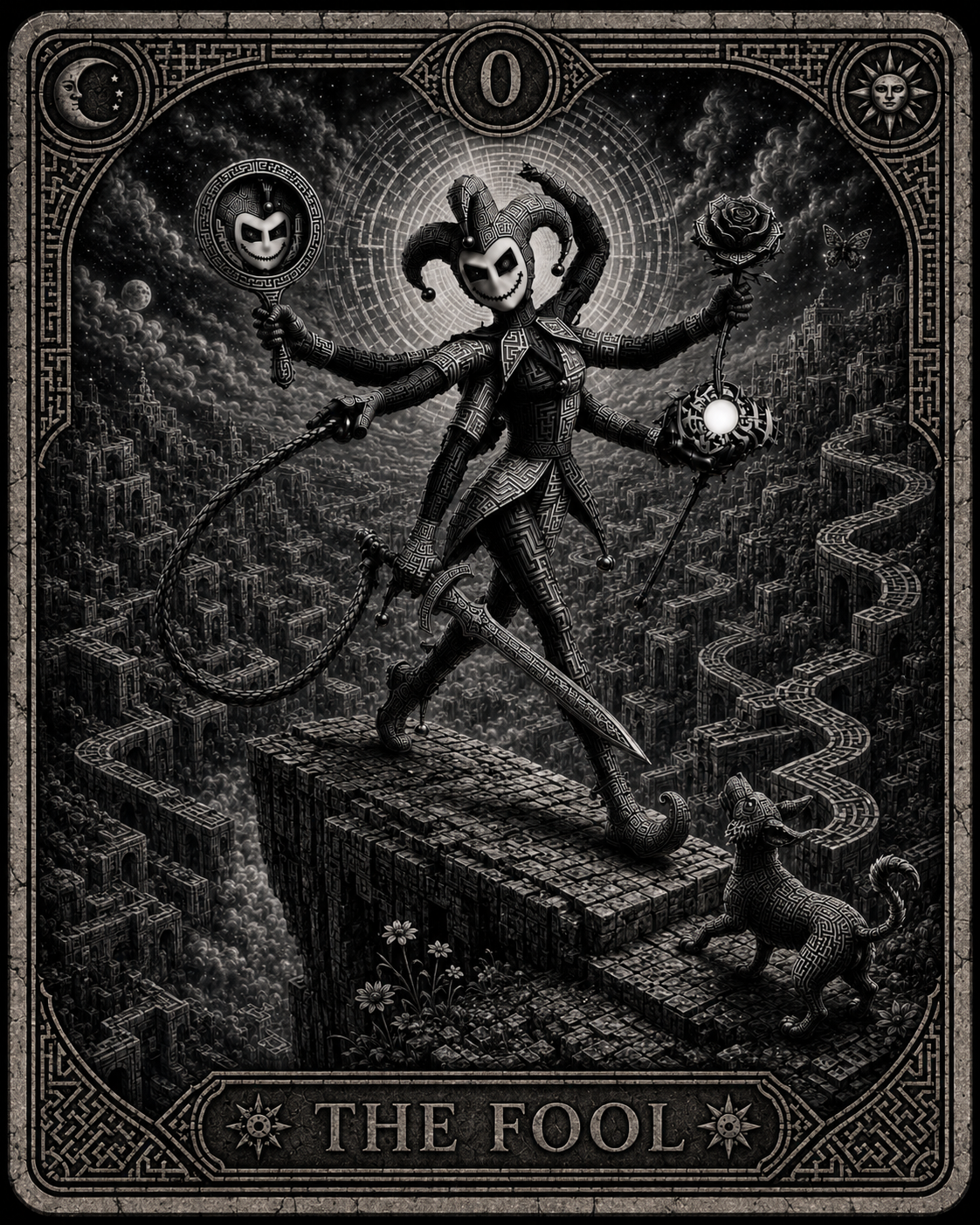
The Fool
The Fool is not simply the idiot, the clown, or the person who does not understand the world.
Metaphysically, the Fool is the part of consciousness that has not been fully captured by the mask.
Every system needs masks to function: roles, titles, seriousness, discipline, performance, reputation, authority. But when the mask becomes total, the soul starts to suffocate under its own costume. People become efficient, acceptable, productive, and spiritually deadened. They know how to behave, but they no longer know how to play. They know how to survive the world, but they forget how to enter it alive.
That is why the Fool appears.
The Fool is the sacred disruption of false order. He walks into the room and breaks the spell everyone else has agreed to maintain. He says the thing no one is allowed to say. He laughs where the atmosphere has become too rigid. He asks the simple question that exposes the elaborate lie. He is dangerous because he does not fully obey the social hypnosis.
This is why kings kept fools near them. The court jester was not merely entertainment. He was a pressure valve, a mirror, and a spiritual immune response. A kingdom without a Fool becomes diseased by its own seriousness. Authority needs something close enough to speak truth, but strange enough to survive saying it.
The Fool stands at the threshold between worlds: the visible world of status, control, and convention, and the hidden world of instinct, dream, intuition, and divine absurdity. He is both inside and outside. He belongs nowhere completely, which is why he can see what everyone else is too invested to notice.
But there are two kinds of folly.
There is holy folly, which frees the spirit.
And there is shadow folly, which traps the spirit in chaos.
The holy Fool is innocent, but not empty. He may look ridiculous, but he carries a deeper intelligence than respectability can recognize. He is willing to be laughed at because he is not enslaved by the audience. He can make himself small without losing his soul. His humor opens the heart. His play dissolves shame. His truth cuts through illusion without becoming cruel.
The shadow Fool is different. He becomes the clown who cannot remove the face. He performs so long that the performance eats him. Laughter becomes defense. Chaos becomes identity. The joke becomes a wound with makeup on it. This is where the Fool begins to rot into the trickster, the manipulator, or the Joker figure: someone no longer laughing with the world, but laughing at its collapse.
The difference is love.
The Fool laughs to restore life.
The trickster laughs to feed on humiliation.
The holy Fool can be ridiculous without becoming malicious. He can expose corruption without losing tenderness. He can speak uncomfortable truths without turning truth into a weapon for ego.
This is why the Fool is tied to the beginning of the spiritual journey. In Tarot, he is numbered zero: the circle before form, the womb before identity, the soul before it is assigned a role. Zero is emptiness, but not nothingness. It is pure potential. The Fool steps off the cliff because every real transformation begins before the mind has secured permission.
The ego wants guarantees.
The soul wants movement.
The Fool is the one who moves.
He enters the unknown before the old self has finished making excuses. He asks the forbidden question. He follows the strange road. He risks appearing foolish because the greater danger is becoming spiritually frozen.
This is also why the Fool heals the Fisher King wound. The wounded king cannot heal himself through more authority, more knowledge, or more control. The sterile kingdom is restored by the innocent question. The cure comes from the part of the psyche that was dismissed, mocked, exiled, or called useless.
What was rejected becomes the key.
The Fool is the despised fragment that still remembers wholeness.
Modern life suffers from a famine of sacred foolishness. Everyone is trained to brand themselves, optimize themselves, explain themselves, defend themselves, and perform competence at all times. But the soul does not awaken through constant self-management. It awakens when something sincere breaks through the performance.
A laugh.
A risk.
A question.
A confession.
A step into the unknown.
The Fool is not anti-wisdom. He is the doorway into a wiser wisdom: the kind that knows knowledge has limits, seriousness can become vanity, and truth often arrives dressed in absurdity.
To become whole, one must make room for the Fool without being consumed by folly. The Fool needs the Sage, and the Sage needs the Fool. Without the Sage, the Fool falls off the cliff. Without the Fool, the Sage becomes a statue.
The sacred task is not to kill the Fool, but to redeem him.
To let him play without letting him decay.
To let him speak without letting him become cruel.
To let him lead into mystery without abandoning discernment.
Because the Fool is the first step of the journey and the last laugh at the end of it. He is the part of the soul that survives the mask, slips past the guards, and whispers the truth everyone else forgot:
You were not born merely to behave.
You were born to become.
Continue the framework
Unlock the mechanics of perception, signal transmission, and reality alteration.